Product guide
AI meal planner: a day of eating built around your numbers
How a meal planner turns a calorie and macro target into actual meals, which diet styles it supports, and why the plan matters less than what you learn from it.
Last reviewed August 30, 2026 by the Caloris nutrition product team.
How the planner builds a day
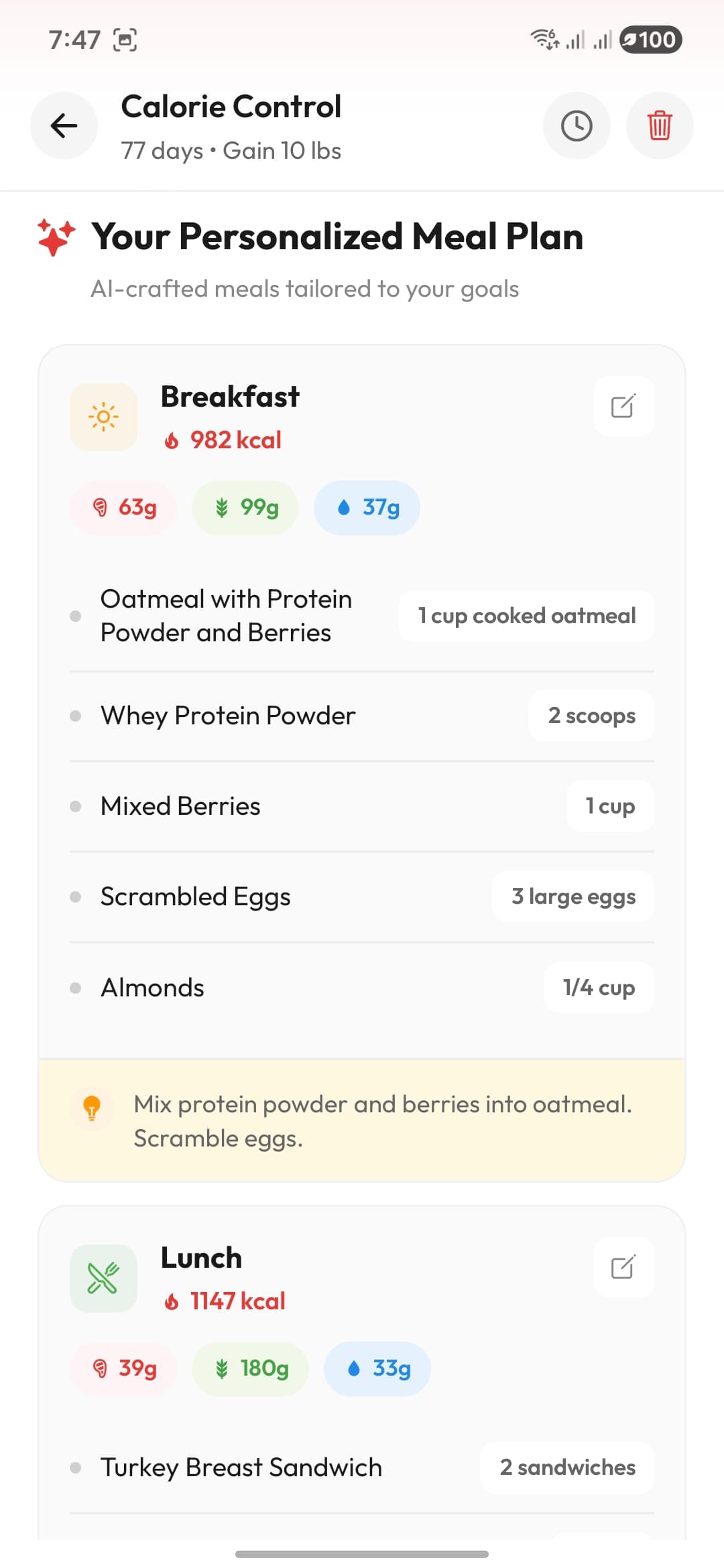
Meal planning is a constraint problem. The planner is given a set of targets and a set of preferences, and has to produce meals that satisfy both:
- Set the calorie ceiling. Taken from your goal — maintenance minus a deficit for fat loss, or plus a surplus for gaining.
- Fix the protein floor first. Protein is the constraint that matters most in a deficit, so it gets allocated before carbohydrate and fat are balanced around it.
- Apply your dietary style. Keto, high protein, low carb, balanced or endurance — this sets the ratio the remaining calories are divided by.
- Distribute across meals. Spread over breakfast, lunch, dinner and snacks so no single meal carries an unrealistic share, and protein appears in each one.
- Respect the practical constraints. Foods you do not eat, meals you do not have time to cook, and an eating window if you are fasting.
Diet styles and what each split looks like
| Diet style | Protein / Carbs / Fat | Best suited to |
|---|---|---|
| Balanced | 30 / 40 / 30 | General health, body recomposition, people new to tracking |
| High protein | 40 / 35 / 25 | Fat loss while training; protects lean mass and controls hunger |
| Low carb | 35 / 20 / 45 | People who feel better on fewer carbohydrates without full keto |
| Keto | 25 / 5 / 70 | Ketogenic eating; requires consistency to be worth the restriction |
| Endurance | 25 / 55 / 20 | Runners, cyclists and anyone training long or twice a day |
None of these is inherently superior. Adherence is what separates diets that work from diets that do not, and adherence is mostly a function of whether you enjoy eating that way. Pick the split closest to how you already eat, then run it through the macro calculator to see the gram targets.
What a 1,800-calorie high-protein day looks like
A worked example is more useful than a description. This is a typical day at roughly 1,800 calories with 150 g of protein — a common target for a woman of average height in a moderate deficit, or a smaller man cutting:
| Meal | Example | Calories | Protein |
|---|---|---|---|
| Breakfast | Greek yoghurt, berries, oats and a scoop of whey | ~420 kcal | 38 g protein |
| Lunch | Chicken breast, basmati rice, roasted vegetables, olive oil | ~610 kcal | 48 g protein |
| Snack | Cottage cheese with an apple | ~230 kcal | 22 g protein |
| Dinner | Salmon fillet, potatoes, green salad | ~540 kcal | 42 g protein |
| Total | — | ~1,800 kcal | 150 g protein |
Figures are rounded illustrative estimates for typical portion sizes, not values from a specific recipe. Your own totals will depend on exact quantities and preparation.
Fasting, and how planning fits around it
If you use intermittent fasting, the plan has to fit the eating window rather than the clock. A 16:8 schedule usually means two substantial meals and one snack instead of three meals plus snacks, which pushes each meal higher in calories and makes hitting a protein target in fewer sittings the main challenge. Caloris includes a fasting timer alongside the food log so the window and the intake are visible in one place.
Why plans fail, and what to do instead
Meal plans fail predictably. Someone follows it precisely for four days, hits a work dinner or a bad night’s sleep, eats something off-plan, and treats the whole thing as broken. The plan was never the point.
Treat a generated plan as a reference for portion sizes and combinations, not a contract. Then log what you actually eat — which is where an AI calorie counter earns its place, because it takes seconds and therefore survives the days when a plan does not. Over a month, the log tells you far more about your eating than the plan ever did.
Planning and tracking in the same app
Caloris keeps the plan and the log together: the planner sets the targets, the AI food scanner records what you actually ate against them, and the daily view shows the gap. Water, fasting windows, exercise and weight sit alongside, so you are not stitching four apps together to see one picture.
Start with the calorie calculator to get your target, then let the planner build around it.
Frequently asked questions
What is an AI meal planner?
An AI meal planner generates a day or week of meals that add up to a specific calorie and macronutrient target, taking your dietary preferences and goal into account. Instead of you assembling meals and checking afterwards whether the totals work, the planner solves it in the other direction: it starts from the target and builds meals that fit.
Does the Caloris AI meal planner cost anything?
Caloris is free to download from Google Play and the core tracking features work without payment. Meal planning is part of the app's premium feature set, available through optional in-app purchase.
Can it handle keto, high protein or low carb diets?
Yes. The planner works from a macro split rather than a fixed menu, so it can build around keto (very low carbohydrate, high fat), high protein, low carbohydrate, or a balanced split. If you want to see what those splits look like in grams before you commit to one, run your calorie target through the macro calculator.
How many calories should my meal plan be?
That depends on your maintenance calories and your goal. Work out your total daily energy expenditure first, then subtract 250–500 calories a day for fat loss or add the same for a lean gain. For most adults a weight-loss plan lands somewhere between 1,400 and 2,200 calories a day, but the correct number is personal — use the calorie calculator rather than a generic figure.
Are AI-generated meal plans safe to follow?
For generally healthy adults eating above the conventional calorie floors, a plan built around sensible macro targets is a reasonable starting point. It is not medical nutrition therapy. If you are pregnant, managing diabetes, kidney disease, an eating disorder or any condition affected by diet, or taking medication that interacts with food, get a plan from a registered dietitian or your doctor instead.
What if I do not like the meals it suggests?
Swap them. A meal plan is a template, not a prescription — the calorie and macro totals are what matter, not the specific dishes. The practical use of a generated plan is that it shows you what portion sizes and food combinations hit your numbers, which is knowledge you keep even when you cook something else.
Do I still need to track food if I follow a meal plan?
Yes, at least at first. Plans describe intentions; logging records what actually happened, including the snacks, drinks and second helpings that no plan anticipates. Tracking for the first few weeks tells you how closely your real eating matches the plan, which is usually the most informative thing you learn.
Plan the day, then log what really happened
Caloris combines an AI meal planner with a photo-based food log, so your targets and your actual intake live in one place.
- Free to download
- Photo, barcode or text logging
- No credit card to start

10,000+ downloads · Rated for 3+
Keep reading
- AI Calorie CounterHow AI calorie counting works, and how accurate it is.
- AI Food ScannerScan any meal with your camera to get calories and macros.
- For Weight LossSet a calorie deficit and track it without the busywork.
- Macro CalculatorProtein, carb and fat targets for your goal.
- Calorie CalculatorHow many calories should you eat per day?
- How to Count CaloriesA practical beginner's guide that actually sticks.